
Long Road Home
As friends and family congratulate me on a new chapter in my life, it got me thinking. They mean well, and I'm genuinely grateful. My counseling degree represents years of work, hours of study, supervision, and more than a few moments of wondering if I had lost my mind embarking on a new career in my 50s.
But every time someone says, "Congratulations on your new chapter," I find myself hesitating—not because they're wrong, but because it doesn't feel like a new chapter, per se.
It feels more like I've finally figured out what the book has been about.
For a long time, I thought I was writing a series of different stories. The Marine Corps was one. Teaching was another. Opening a brewery was a third. Coaching, public speaking, graduate school...they all felt like separate plots with different protagonists. I kept introducing new characters, hoping one of them would finally answer the question, "Who am I?"
Maybe that's why transitions and threshold moments have always fascinated me. We usually think of them as moments when we're supposed to become someone else. A new promotion or title. More letters after our name. A new relationship. A bigger home. We imagine each achievement introducing a stronger, wiser, more successful character into the story. Lately, though, I've begun to wonder if transformation works conversely.
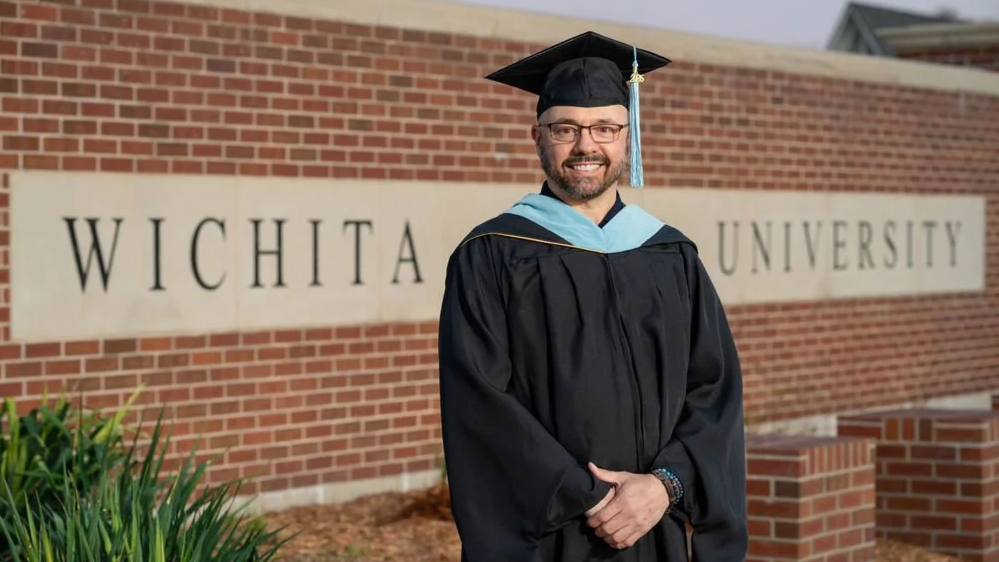
Special thanks to Darrin Hackney Photography for capturing my graduation in May 2026.
Maybe becoming isn't about creating a new character at all. Maybe it's about finally understanding the ones we've already written. That's a subtle distinction, but it's changed the way I think about my own journey.
When I left the Marine Corps, as I took off the uniform for the last time, I thought I was writing one character out of the story. When the brewery closed, and I struggled through depression and bankruptcy, I believed another had reached an unsatisfying ending. Even as I entered graduate school the second time, there was a part of me that wondered if counseling was simply the next character I was trying to become.
It wasn't.
It was integration.
The Marine, the Teacher, the Entrepreneur, the Coach, the Student, and now, the Counselor: looking back, I don't see competing identities anymore. I see characters who each had something important to contribute to the story. The Marine taught me discipline. The Teacher cultivated curiosity. The Entrepreneur humbled me. Loss deepened my empathy. Counseling didn't replace any of them. It simply gave each of those characters a seat at the same table, allowing them to work together in service of other people.
That's probably the biggest surprise. I expected to finish graduate school with more answers. Instead, I finished with more acceptance. I now accept that very little of my life was wasted. I see the detours often became the road I owned. And perhaps most importantly, I know that grief isn't something we experience only after death. We grieve versions of ourselves that once served us well but can no longer carry the story forward.
I've explained before that transformation demands loss.
I'm beginning to think the opposite is also true. Loss invites transformation. Not because pain is inherently good, but because it has a way of stripping away the illusion that we have to keep auditioning for a better role. Maybe that's why this season feels different. I don't feel like I've become a counselor. I feel like I've stopped trying to replace the characters who brought me here and began accepting them for who they are and the ways they haved served.
There is a strange peace that comes when your story stops feeling fragmented. When the chapters that once seemed unrelated suddenly reveal themselves as parts of the same narrative. You stop asking, "Why did that happen?" and begin asking, "What was that preparing me to understand?"
I suspect that's true for more people than realize it. Most of us spend years worrying that we're behind, that we've taken too many wrong turns, or that we've somehow missed our calling.
What if those seasons weren't wrong?
What if those earlier versions of ourselves weren't failed attempts at becoming who we were supposed to be?
What if they were simply the cast of characters our story required?
To me, that's what self-authorship is beginning to mean. The goal isn't to erase earlier characters or pretend they never existed. It isn't to look back with embarrassment or regret. It's to honor them. To thank them. To grieve them when their season has ended. And then to let them continue living—not as competing identities, but as integrated voices that help author the chapters still waiting to be written.
Perhaps becoming isn't about imagining the person you'll be someday.
Perhaps it's about learning to appreciate every character who made you who you are today.